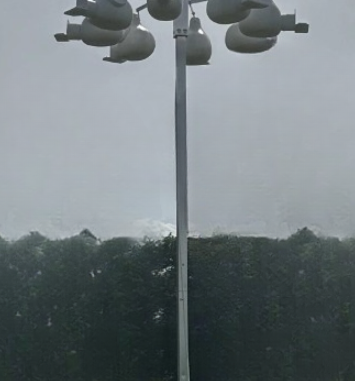
Have you ever walked through a public park and noticed a tall metal pole holding several unusual white containers?
From a distance, these objects can look remarkably similar to security cameras, weather-monitoring equipment, or some kind of advanced surveillance technology.
Their strange appearance often raises questions among visitors who have never seen them before.
The poles can stand more than 12 feet tall, with multiple rounded white structures suspended near the top. Some arrangements resemble clusters of small pods, while others look like miniature houses hanging in the air.
But despite their unusual design, these installations have nothing to do with monitoring people or collecting weather information.
They are actually specialized birdhouses designed for one of North America’s most fascinating migratory birds.
Known as purple martin gourd houses, these structures provide nesting spaces for purple martins, a species of swallow admired for its beautiful plumage, remarkable flying abilities, and social behavior.
What might initially appear to be mysterious technology is actually part of a longstanding relationship between humans and wildlife.
What Exactly Are Purple Martins?
Purple martins are the largest swallows found in North America.
These graceful birds are known for their impressive flying skills and their ability to capture insects while moving through the air.
Adult males have glossy, dark feathers that can appear almost black from a distance.
Under favorable lighting, however, their plumage reveals a beautiful blue-purple iridescence.
Females and younger birds have a different appearance, with lighter underparts and less extensive dark coloring.
Purple martins are highly active birds, frequently seen soaring, gliding, and making rapid turns while searching for food.
Their energetic movements make them particularly enjoyable for birdwatchers.
They are also known for their distinctive vocalizations, which include a variety of chirps, whistles, and gurgling sounds.
Unlike many birds that prefer isolated nesting locations, purple martins are comfortable living in colonies.
This social behavior makes specially designed nesting structures particularly useful.
Fascinating Characteristics of Purple Martins
Several features distinguish purple martins from other familiar backyard birds.
Their Impressive Size
Purple martins generally measure approximately 7 to 8 inches in length.
Their wingspan can reach around 15 to 16 inches, allowing them to travel efficiently through open air.
Their streamlined bodies and pointed wings are well suited to catching flying insects.
Their Feeding Habits
Purple martins feed primarily on insects captured during flight.
Their diet can include beetles, dragonflies, moths, flies, and other airborne insects.
Although they occasionally consume mosquitoes, research does not support the popular claim that purple martins eat enormous numbers of mosquitoes every day.
They generally hunt at heights where many other flying insects are more abundant.
Nevertheless, they are important insect-eating birds within their ecosystems.
Their Long-Distance Migration
Each year, purple martins travel between their breeding grounds in North America and wintering areas in South America.
Brazil is an especially important wintering region for the species.
Their annual migration can cover thousands of miles, making their return each spring a highly anticipated event among bird enthusiasts.
Their Social Nature
Purple martins often nest near others of their species.
Multiple breeding pairs may occupy separate compartments within the same birdhouse system.
This preference for colony nesting helps explain why purple martin housing frequently includes numerous individual chambers grouped together.
Why Do Purple Martins Use Artificial Birdhouses?
One of the most interesting aspects of purple martin behavior is their relationship with human-provided nesting structures.
Purple martins are cavity-nesting birds.
Instead of building exposed nests in tree branches, they seek enclosed spaces where they can raise their young.
Historically, suitable cavities included holes in dead trees, natural openings, and abandoned woodpecker nests.
However, nesting habits vary across North America.
In western regions, purple martins continue to use natural cavities and other nesting locations.
In much of eastern North America, by contrast, they have developed a strong association with artificial housing provided by people.
This relationship has existed for generations.
A Tradition That Began Long Ago
Long before modern plastic birdhouses became available, people were already providing nesting spaces for purple martins.
Indigenous communities in North America are known to have used hollowed-out gourds as nesting containers.
These natural vessels offered enclosed spaces where the birds could establish nests.
Later, settlers also adopted the practice of hanging gourds near homes and agricultural areas.
Over time, the tradition became an established part of purple martin conservation and birdwatching.
Today, enthusiasts continue providing artificial nesting structures using materials such as plastic, aluminum, and specially designed wooden housing.
Although the materials have changed, the underlying idea remains much the same.
A suitable nesting cavity can encourage purple martins to establish breeding colonies in locations where appropriate habitat is available.
Why Are the Birdhouses Shaped Like Gourds?
The rounded design of many modern purple martin houses reflects the traditional use of natural gourds.
Before manufactured birdhouses became common, dried gourds were hollowed out and fitted with entrance holes.
Their naturally enclosed shape made them useful nesting containers.
Modern versions preserve this familiar appearance while incorporating practical improvements.
Many are manufactured from durable materials designed to withstand outdoor conditions.
They may also include access panels, drainage openings, ventilation features, and specially shaped entrances.
These details can make the housing easier to maintain and more suitable for nesting birds.
The result is a structure that looks unusual to people but serves a very specific purpose.
Protection From Predators
A major concern for purple martin colonies is predation.
Snakes, raccoons, and other animals may attempt to reach nests containing eggs or young birds.
Simply placing gourds high above the ground does not guarantee protection.
Some predators are excellent climbers and can reach elevated nesting structures.
For that reason, well-designed purple martin installations often include specialized predator guards.
These guards are attached to the supporting pole and help prevent climbing animals from reaching the nesting chambers.
Proper entrance design and regular monitoring can also reduce certain risks.
The combination of suitable housing and effective predator protection can improve nesting success.
Space for Raising Young Birds
Each gourd functions as a separate nesting compartment.
A breeding pair can use the enclosed space to construct a nest and raise its chicks.
Purple martins typically build nests using plant material such as grasses, leaves, and small twigs.
The female lays her eggs inside the protected chamber, where the parents care for the developing young.
Modern gourds are often designed to provide adequate interior space for growing chicks.
Some systems also include features that allow caretakers to inspect nests without dismantling the entire installation.
These practical improvements make artificial housing valuable for people managing established colonies.
Ventilation and Drainage Are Essential
Like other nesting birds, purple martins need protection from excessive moisture and heat.
Poorly ventilated nesting compartments can become uncomfortable during hot weather.
Water entering a nest may also create unhealthy conditions for eggs and chicks.
For these reasons, quality purple martin housing generally incorporates drainage and ventilation features.
Small openings can allow water to escape while helping air circulate through the chamber.
Proper design is particularly important in areas with high summer temperatures or frequent rainfall.
Regular maintenance helps ensure these features continue functioning as intended.
Why Are So Many Gourds Attached to One Pole?
Purple martins are colonial nesters, which means several pairs may breed close together.
Rather than providing a single birdhouse, caretakers often install multiple nesting compartments on one support system.
The gourds may be arranged in circular groups or suspended from horizontal arms near the top of a pole.
Each chamber provides a separate nesting location.
This arrangement allows several pairs to occupy the same general area while maintaining individual nests.
For observers unfamiliar with the design, the cluster of rounded containers may resemble scientific equipment.
But the arrangement is intended to accommodate the birds’ natural social behavior.
Why These Structures Are Often Installed in Open Parks
Purple martins generally prefer nesting locations with open surroundings.
They need sufficient space to approach and leave their nesting cavities while flying.
Tall trees and buildings positioned too close to a nesting structure can make the site less attractive.
Public parks, open lawns, and other spacious areas can therefore provide suitable locations when properly managed.
A successful site also benefits from appropriate food availability and a relatively safe environment.
The presence of open flying space is one reason these unusual poles may appear in the middle of grassy areas rather than deep within wooded sections.
Their placement is deliberate.
The goal is to create conditions that encourage purple martins to establish and maintain breeding colonies.
The Importance of Artificial Housing
In eastern North America, human-provided housing plays a major role in purple martin nesting.
Properly maintained structures can provide breeding opportunities for birds that have become strongly associated with artificial nest sites.
However, installing a birdhouse does not automatically guarantee that purple martins will use it.
Location, colony history, nearby habitat, competition, and housing maintenance all influence whether the birds establish themselves.
Some sites attract martins quickly.
Others may take several breeding seasons to become occupied.
Conservation-minded caretakers often monitor their installations and make adjustments when necessary.
Their efforts help support nesting opportunities while providing valuable information about local bird populations.
Competition From Other Birds
Purple martins can face competition from other cavity-nesting species.
In particular, invasive European starlings and house sparrows may occupy artificial nesting chambers.
These birds can compete with purple martins for space and sometimes interfere with nesting attempts.
For this reason, successful colony management may require regular inspections and appropriate control measures consistent with local wildlife regulations.
Some modern gourd systems use specially shaped entrances designed to reduce access by certain competing birds.
However, no single feature eliminates every potential problem.
Consistent monitoring remains important.
Do Purple Martins Help Control Insects?
Purple martins are skilled aerial insect hunters.
They capture a wide variety of flying insects, contributing to natural food-web relationships.
Their feeding habits make them an interesting part of local ecosystems.
However, they should not be viewed as a guaranteed solution for mosquitoes or other unwanted insects.
Despite a longstanding popular belief, purple martins do not specialize in consuming large numbers of mosquitoes.
Their diet varies according to available prey, weather, location, and season.
Still, encouraging native insect-eating birds can contribute to a diverse and healthy environment.
The ecological value of purple martins extends beyond any single pest-control benefit.
Why Some Poles Have Pulley Systems
If you examine a purple martin housing installation closely, you may notice that the supporting pole includes a cable, pulley, or telescoping mechanism.
These features are not part of a surveillance system.
They allow caretakers to lower the nesting compartments for inspection and maintenance.
Without such mechanisms, reaching houses mounted high above the ground would be difficult.
A lowering system can make it easier to examine nests, clean compartments when appropriate, and check for damage.
Caretakers may also use these inspections to monitor nesting activity and identify potential problems.
When conducted carefully and according to recommended practices, nest checks can support effective colony management.
What Is the Metal Guard Near the Bottom?
Another feature that sometimes confuses park visitors is the smooth metal structure attached to the lower portion of the pole.
This component is usually a predator guard.
Its purpose is to make it harder for climbing animals to reach the nesting chambers.
Different installations may use cylindrical guards, cone-shaped barriers, or other protective designs.
These devices are particularly important because elevated nests can still be vulnerable to snakes and mammals capable of climbing poles.
A properly installed guard provides an additional layer of protection for nesting birds.
How People Can Support Purple Martins
People interested in helping purple martins can begin by learning about their habitat requirements.
A suitable nesting site generally needs open space, properly designed housing, and ongoing maintenance.
Installing gourds in a heavily wooded backyard may not produce the desired results.
Similarly, poorly maintained housing can create problems rather than benefits.
Those considering a purple martin colony should research appropriate placement, predator protection, entrance design, and seasonal care.
Local birding organizations and purple martin conservation groups can provide guidance.
Even people who cannot install nesting structures can support these birds by protecting natural habitats and observing wildlife responsibly.
A Fascinating Example of Humans Helping Wildlife
The relationship between purple martins and artificial nesting structures demonstrates how human activities can influence animal behavior over generations.
In eastern North America, the use of human-provided housing has become a familiar part of the species’ breeding ecology.
Today, a carefully managed collection of gourds can provide nesting opportunities while allowing people to observe the birds’ remarkable behavior.
Watching purple martins return in spring, establish nests, and raise their young can be a rewarding experience.
Their graceful flight and social interactions make them especially appealing to birdwatchers.
And for people who have never encountered these unusual birdhouses before, learning their purpose can completely change how they view the strange white objects mounted above park lawns.
Final Thoughts
The next time you notice a tall pole covered with white, rounded containers in a park, don’t immediately assume you’re looking at cameras or weather-monitoring devices.
You may be seeing a specially designed nesting system for purple martins.
These unusual gourd houses reflect a longstanding tradition of providing nesting spaces for one of North America’s most admired migratory birds.
Their elevated design, multiple compartments, maintenance mechanisms, and predator guards all serve practical purposes.
Far from being mysterious surveillance equipment, they are examples of wildlife-friendly infrastructure intended to support breeding birds.
Sometimes, the strangest-looking objects in our parks have the most wonderful explanations. What appears to be modern technology may actually be a carefully designed home for an extraordinary little bird.