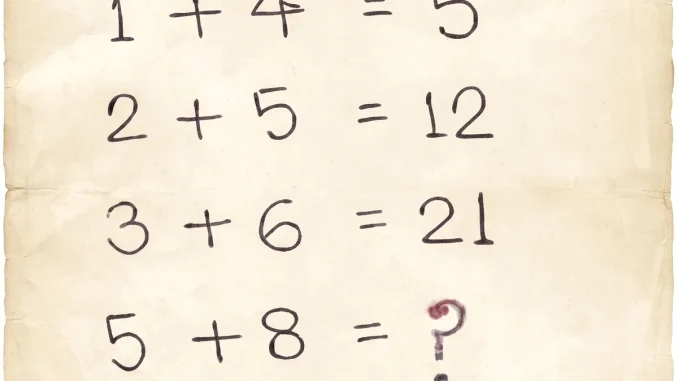
Mathematical puzzles that involve number sequences often present an intriguing challenge, not because they require complex calculations, but because they demand careful observation and pattern recognition. These puzzles encourage critical thinking and offer an opportunity to explore how numbers can relate to each other beyond basic arithmetic.
One well-known type of number puzzle involves a series of equations where the operations appear straightforward at first glance but conceal a deeper pattern. Consider the following sequence:
1 + 4 = 5
2 + 5 = 12
3 + 6 = 21
5 + 8 = ?
At face value, these equations resemble simple addition problems. However, the results after the equal sign do not align with the conventional sums of the numbers on the left-hand side. This discrepancy suggests that a hidden rule or pattern is influencing the outcomes.
One way to approach this puzzle is to look for a relationship that extends beyond the immediate addition. For example, observe the results and consider whether they incorporate previous results in the sequence. Starting with the first equation, 1 + 4 equals 5, which matches the result provided.
Moving to the second equation, the sum of 2 + 5 is 7, but the provided result is 12. If we add the previous result (5) to this sum (7), we get 12, which matches the second equation’s result. This suggests a pattern where each result is the sum of the current addition plus the previous result.
Applying this logic to the third equation, 3 + 6 equals 9. Adding the previous result (12) yields 21, which again aligns with the given answer. Following this pattern, the fourth equation would be calculated as 5 + 8 (which is 13) plus the previous result (21), totaling 34.
This method highlights how recognizing cumulative addition can explain the results in the sequence. It shows the importance of looking beyond the superficial operations and considering how earlier outcomes influence subsequent calculations.
However, it is worth noting that number puzzles can often be interpreted in multiple ways, especially when the pattern is not explicitly stated. For instance, some might propose alternative interpretations that lead to a different answer, such as 45, by applying a different rule or mathematical relationship.
This ambiguity reflects a key aspect of puzzle-solving: the need to identify a consistent and logical rule that applies uniformly across the entire sequence. The challenge, therefore, is not only to compute the final answer but also to understand the underlying principle that governs the sequence.
In educational contexts, puzzles like this serve to develop analytical skills and encourage learners to test hypotheses and verify their consistency. By exploring different possibilities and checking their validity against all given equations, one cultivates a systematic approach to problem-solving.
In summary, this classic math puzzle demonstrates how pattern recognition is essential in interpreting number sequences. While the direct calculation of 5 + 8 + 21 results in 34 following the cumulative addition pattern, the broader lesson lies in examining the reasoning process that leads to this conclusion. Such puzzles foster critical thinking and highlight the richness of mathematical exploration beyond rote computation.
Exploring Alternative Patterns and Their Implications
While the cumulative addition pattern provides a coherent explanation for the sequence, it is valuable to consider other possible rules that might fit the given equations. This exploration underscores the complexity inherent in number puzzles, especially when the pattern is not explicitly stated.
One alternative approach involves examining the product of the two numbers on the left-hand side and then adding one of the operands. For example, the first equation, 1 + 4 = 5, could be interpreted as (1 × 4) + 1 = 5. Applying this logic to the second equation, (2 × 5) + 2 = 12, which matches the result. Extending this to the third equation, (3 × 6) + 3 = 21, again consistent with the given answer.
Using this pattern for the fourth equation would result in (5 × 8) + 5 = 45, which is why some people suggest 45 as the answer. This example highlights how different valid patterns can exist for the same set of equations, emphasizing the importance of clearly defining the rule in puzzles.
Understanding these alternative interpretations encourages flexibility in thinking and an appreciation for the diversity of mathematical relationships. It also illustrates that context and clarity are critical in puzzle design to avoid ambiguity.
The Role of Pattern Recognition in Mathematics and Beyond
Pattern recognition is a fundamental cognitive skill not only in mathematics but also in various domains such as science, language, and everyday problem-solving. In mathematics, recognizing patterns helps simplify complex problems, predict future outcomes, and develop formulas.
In the context of number puzzles, pattern recognition involves identifying relationships between numbers that may include arithmetic operations, geometric progressions, or more abstract connections. This skill is essential for students and professionals alike, fostering logical thinking and analytical abilities.
Beyond academics, pattern recognition plays a crucial role in fields like computer science, where algorithms often depend on detecting patterns in data. Similarly, in finance, recognizing market trends involves identifying numerical and behavioral patterns.
Therefore, engaging with puzzles like the one discussed helps develop a transferable skill set that benefits various aspects of intellectual and professional life.
Educational Value of Number Sequence Puzzles
Number sequence puzzles serve as excellent educational tools. They stimulate curiosity and encourage learners to engage actively with mathematical concepts rather than passively memorizing formulas.
By working through these puzzles, learners practice hypothesizing different rules, testing their validity, and refining their understanding based on feedback. This iterative process mirrors scientific inquiry and promotes a growth mindset.
Moreover, such puzzles help students appreciate the creative side of mathematics, showing that it is not merely about numbers but about discovering relationships and patterns.
Instructors often use these puzzles to introduce concepts such as sequences and series, recursion, and functional relationships. They can be adapted for various skill levels, making them versatile tools in educational settings.
The Importance of Clear Problem Statements
The ambiguity in patterns, as seen in this puzzle, highlights the importance of clear problem statements in educational and professional contexts. When the rules or constraints of a problem are not explicitly defined, multiple interpretations can arise, potentially leading to confusion or frustration.
Clear communication ensures that problem solvers understand the parameters and can focus on applying logical reasoning rather than guessing the intended rule. This clarity is particularly crucial in standardized testing, programming, and collaborative work environments.
In puzzle design, providing hints or examples can help guide solvers toward the intended pattern without diminishing the challenge. In academic assessments, clarity helps accurately measure understanding and problem-solving abilities.
Encouraging Critical Thinking and Logical Reasoning
Engaging with puzzles that offer multiple plausible solutions fosters critical thinking skills. Solvers learn to evaluate different hypotheses, weigh evidence, and justify their reasoning.
This process encourages metacognition—thinking about one’s thinking—which is vital for effective learning and decision-making. It also cultivates intellectual humility, as learners recognize that initial assumptions may need revision.
In professional contexts, such skills translate into better problem-solving, adaptability, and innovation. Being able to approach problems from multiple angles and select the most appropriate solution is invaluable across disciplines.
Legacy and Popularity of Number Puzzles
Number puzzles have a long history, with roots tracing back to ancient civilizations where they were used for entertainment, education, and even religious purposes. Over time, they have evolved into various forms, including magic squares, Sudoku, and logic puzzles.
Their enduring popularity stems from their accessibility and the satisfaction derived from uncovering hidden patterns. They are often shared across cultures and generations, contributing to a shared mathematical heritage.
In contemporary times, number puzzles have found new life through digital platforms and mobile applications, reaching wider audiences and integrating with educational technologies.
Reader Takeaways
When approaching number sequence puzzles, it is helpful to:
- Look beyond surface-level operations to identify potential hidden patterns.
- Consider multiple hypotheses and test their consistency against all given information.
- Recognize that some puzzles may have more than one valid solution depending on the rules applied.
- Appreciate the role of clear problem statements in guiding effective problem-solving.
- Use such puzzles as opportunities to develop critical thinking, logical reasoning, and pattern recognition skills.
By embracing these strategies, readers can enhance their mathematical intuition and enjoy the rich intellectual experience that such puzzles offer.
Strategies for Approaching Ambiguous Math Puzzles
When faced with a math puzzle that lacks a clearly defined pattern, such as the number sequence discussed earlier, adopting a systematic approach can be highly beneficial. One recommended strategy is to list all given information and constraints explicitly. This helps prevent overlooking details that might hint at the underlying rule.
Next, generating multiple hypotheses about possible patterns encourages creative thinking and broadens the problem-solving perspective. Testing each hypothesis against all known data points ensures consistency and helps eliminate incorrect options. For example, in the puzzle with equations 1 + 4 = 5, 2 + 5 = 12, and so on, trying both cumulative addition and multiplication-based patterns demonstrated how different rules could fit the same sequence.
Another useful tactic is to look for common mathematical concepts such as arithmetic progressions, geometric progressions, factorials, or recursive definitions. Sometimes, the pattern may involve operations like exponentiation, modular arithmetic, or even concatenation of digits rather than traditional arithmetic.
Collaborative problem-solving can also enhance understanding. Discussing puzzles with peers or mentors can introduce fresh perspectives and uncover overlooked insights. Online forums and educational platforms often provide communities where such exchanges take place.
Finally, patience and persistence are crucial. Some puzzles are intentionally designed to challenge assumptions and require multiple attempts before the correct pattern emerges. Embracing the process as a learning experience rather than solely seeking the correct answer fosters resilience and intellectual growth.
The Intersection of Number Puzzles and Algorithmic Thinking
Number sequence puzzles are not only recreational challenges but also serve as foundational exercises in algorithmic thinking. Algorithmic thinking involves breaking down problems into step-by-step procedures or rules, which computers can follow to solve tasks.
For instance, the cumulative addition pattern identified in the earlier puzzle can be expressed algorithmically as: for each equation, add the two numbers on the left-hand side and then add the result of the previous equation. This recursive approach is fundamental in programming and computer science.
Understanding such patterns aids in designing algorithms for data processing, encryption, and artificial intelligence. By practicing with number puzzles, learners develop skills in pattern detection, conditional logic, and iterative processes, all of which are essential in coding and software development.
Moreover, recognizing that multiple algorithms can solve the same problem—akin to multiple patterns fitting the puzzle—encourages flexibility and optimization in problem-solving. These skills are highly valued in technology-related careers and research.
Integrating Number Puzzles into STEM Education
Incorporating number sequence puzzles into Science, Technology, Engineering, and Mathematics (STEM) education can enhance student engagement and deepen conceptual understanding. These puzzles provide concrete examples of abstract mathematical principles and promote active learning.
Educators can use such puzzles to introduce topics like sequences and series, recursion, and functions. By guiding students to discover patterns themselves, teachers foster exploratory learning and critical thinking.
Additionally, puzzles can be adapted to different difficulty levels, making them accessible to a wide range of learners. They also encourage collaboration and communication skills when used in group settings.
Technology integration, such as interactive apps and online platforms, can further enrich the experience by providing immediate feedback and adaptive challenges. This approach aligns with modern educational methodologies that emphasize student-centered and inquiry-based learning.
Broader Cognitive Benefits of Puzzle Solving
Engagement with puzzles extends benefits beyond mathematical skills. Research suggests that regular puzzle solving can enhance cognitive functions such as memory, attention, and problem-solving abilities.
For example, recognizing patterns and applying logical reasoning stimulate neural pathways associated with executive functions. These enhancements contribute to better academic performance and everyday decision-making.
Furthermore, puzzles can reduce stress and improve mood by providing a sense of accomplishment and mental stimulation. They also encourage perseverance and patience, qualities valuable in many life contexts.
In older adults, maintaining cognitive engagement through puzzles may support brain health and delay cognitive decline. Thus, puzzle solving is a lifelong beneficial activity.
Cultural Significance and Variations of Number Puzzles
Number puzzles have rich cultural roots and manifest in diverse forms worldwide. Ancient civilizations like the Babylonians and Greeks used numerical riddles for education and entertainment.
Different cultures have developed unique puzzle styles, such as the magic squares popular in Chinese and Islamic traditions or Kakuro puzzles originating in Japan. These variations illustrate the universal appeal of puzzles and their adaptability to various mathematical concepts.
Understanding these cultural contexts enriches appreciation for the puzzles and offers insights into historical mathematical developments. It also promotes cross-cultural learning and respect for diverse intellectual traditions.
In modern times, international puzzle competitions and online communities celebrate this global heritage, connecting enthusiasts across continents.
Tips for Creating Your Own Number Puzzles
Designing original number puzzles can be a rewarding exercise that deepens understanding of mathematical relationships. To create an effective puzzle, start by selecting a clear and consistent pattern or rule.
Test the pattern with multiple examples to ensure it works uniformly. Consider including subtle hints or examples to guide solvers without making the puzzle too easy.
Balance complexity with accessibility; overly complicated rules may discourage participation, while too simple ones might lack engagement.
Once the puzzle is designed, share it with others to gather feedback and observe different solving approaches. This iterative process can improve puzzle quality and offer new perspectives.
Creating puzzles also enhances creativity and problem-solving skills, making it a valuable activity for educators and enthusiasts alike.
Conclusion and Final Reflections
The examination of the classic number sequence puzzle reveals the multifaceted nature of mathematical problem-solving. Beyond calculating results, it invites deeper exploration of patterns, critical evaluation of multiple hypotheses, and appreciation for clear communication.
Such puzzles exemplify how mathematics is not merely about numbers but involves reasoning, creativity, and logical analysis. They serve as gateways to broader intellectual skills applicable in academics, careers, and everyday life.
By engaging thoughtfully with these challenges, learners and enthusiasts can cultivate a richer mathematical intuition and enjoy the enduring satisfaction that comes from uncovering hidden patterns.