It started as an ordinary morning, with nothing suggesting that something unusual was waiting just outside my house. The temperature was pleasantly cool, the neighborhood was peaceful, and the yard appeared exactly as it always did.
But the moment I opened my front door, I noticed something that made me stop in my tracks.
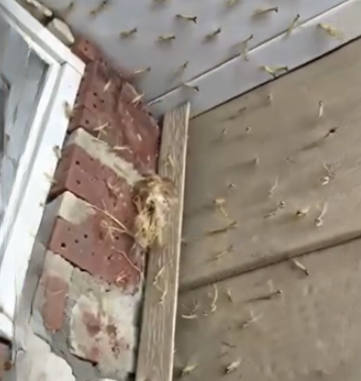
Tiny insects were crawling across the doorstep, moving in different directions. At first, I couldn’t figure out what they were. Their bodies were incredibly small, barely reaching the size of a fingernail, yet their unusual shapes immediately caught my attention.
After taking a closer look, I realized I was witnessing something remarkable: a group of newly hatched praying mantises beginning their lives right outside my home.
The little creatures had emerged from a protective egg case called an ootheca, a fascinating structure produced by female praying mantises to protect their developing offspring.
Unlike the eggs of many other insects, mantis eggs are enclosed inside a hardened, foam-like material that provides protection against changing weather conditions and certain predators.
Female mantises typically attach these egg cases to secure surfaces such as tree branches, wooden fences, garden structures, or even exterior walls of buildings.
Depending on the species, a single egg case may contain dozens or more than a hundred eggs. The young remain protected inside until environmental conditions become suitable for hatching, often during warmer periods of the year.
Finding one of these natural nurseries so close to my entrance was completely unexpected.
It felt as though a secret part of the natural world had suddenly revealed itself in the most familiar place imaginable.
The newly emerged mantises were surprisingly delicate. Their slender bodies had a pale, almost transparent appearance, with subtle shades of green and brown beginning to show.
Despite their fragile appearance, they were already moving with an impressive sense of purpose.
Several climbed along the textured surface of the nearby wall, carefully navigating the tiny gaps between the bricks.
Others headed toward the garden, where leaves, grass, and small plants offered places to hide.
A few disappeared almost immediately into the vegetation, blending so effectively into their surroundings that I could no longer follow their movements.
Watching them spread out was fascinating.
There was no leader guiding the group and no obvious pattern to their movements. Each insect seemed to know instinctively that it needed to find shelter and begin searching for food.
That independence is one of the most extraordinary aspects of a praying mantis’s life.
From the moment they hatch, these insects must rely on their natural abilities to survive.
Praying mantises have long attracted attention because of their distinctive appearance and remarkable hunting behavior.
Their name comes from the way they hold their front legs folded in front of their bodies, creating an appearance that resembles hands joined in prayer.
However, their peaceful-looking posture hides a very different reality.
Those folded front legs are specialized hunting structures, equipped with sharp spines that allow mantises to seize and hold their prey.
Adult praying mantises are skilled ambush predators. Rather than constantly chasing insects, they often remain motionless and wait for unsuspecting prey to approach.
When an opportunity appears, they strike with extraordinary speed.
Even newly hatched mantises possess the basic instincts needed to develop these hunting abilities.
Although their small size limits the prey they can capture, they can begin feeding on tiny insects once they are ready to hunt.
Another remarkable feature is their vision.
Praying mantises have large compound eyes positioned on either side of their heads, giving them an extensive view of their surroundings.
Their visual system is especially well adapted for detecting movement and estimating the distance to potential prey.
This ability becomes increasingly important as they grow and begin targeting larger insects.
Standing beside my front door, I found it difficult to believe that these tiny creatures would eventually develop into such capable hunters.
They looked so vulnerable, yet each carried the instincts necessary to survive in a world filled with danger.
And their presence was more than just an interesting backyard discovery.
Praying mantises play a role in maintaining the balance of insect populations in gardens, fields, and other natural environments.
They feed on a variety of insects, including flies, moths, caterpillars, and other small creatures they can successfully capture.
Because they consume some insects that damage garden plants, mantises are often appreciated by gardeners.
However, they are generalist predators rather than selective pest controllers. They may also eat beneficial insects, including pollinators and other natural predators.
Their contribution to garden ecosystems is therefore more complicated than simply eliminating unwanted pests.
Still, observing these young mantises made me appreciate how many interactions take place in nature without us ever noticing.
What appeared to be an ordinary doorstep had temporarily become the starting point for dozens of independent lives.
Some hatchlings remained almost perfectly still against the brickwork, their slender bodies blending with the uneven surface.
Others continued moving toward nearby plants, occasionally stopping as though assessing their surroundings.
There was something almost hypnotic about their movements.
Unlike many young animals, praying mantises receive no ongoing care from their mothers after hatching.
They must immediately navigate their environment, locate suitable food, and avoid threats.
At such a small size, the dangers are considerable.
Birds, spiders, ants, and other predators may capture young mantises before they have an opportunity to grow.
Sudden weather changes, lack of food, and accidental disturbances can also threaten their survival.
Even something as ordinary as someone walking across the doorstep could harm them.
This vulnerability helps explain why many mantis species produce relatively large numbers of offspring.
Not every hatchling will reach adulthood, but producing numerous young increases the likelihood that some will survive and reproduce.
As I continued watching, the insects gradually moved farther apart.
What had initially looked like a concentrated gathering began spreading across the surrounding garden.
Within a short time, many had disappeared beneath leaves, into grass, or along the edges of nearby plants.
It was surprising how quickly such an unusual scene could return to normal.
Someone arriving at my house an hour later might never have guessed what had happened that morning.
Yet I had witnessed an event that is easy to miss: the emergence of a new generation of praying mantises.
For anyone who discovers newly hatched mantises around their home, the most helpful response is usually to leave them undisturbed.
Young mantises are extremely delicate, and unnecessary handling can injure them.
If they are gathered near a frequently used doorway or walkway, taking extra care while passing through can help prevent accidental harm.
Avoiding insecticides around the hatching area is also beneficial, since chemical treatments may kill young mantises along with other insects.
Nearby shrubs, flowers, and garden plants provide useful hiding places and potential hunting opportunities.
As the young mantises develop, they will go through a series of molts.
During each molt, a mantis sheds its outer exoskeleton to accommodate its growing body.
Unlike butterflies, praying mantises do not pass through a pupal stage. Instead, their immature forms gradually develop into adults through successive molts.
Eventually, surviving individuals will become mature insects capable of reproducing and continuing the life cycle.
Beyond their biological characteristics, praying mantises have also captured the human imagination for generations.
Their unusual appearance and patient hunting style have inspired symbolic associations in different traditions.
In some cultural interpretations, the mantis represents concentration, stillness, patience, or careful observation.
The insect’s ability to remain motionless for long periods before making a precise movement has contributed to these associations.
Whether someone sees a mantis as a symbol of patience or simply an extraordinary insect, its behavior offers plenty to appreciate.
Watching those tiny hatchlings reminded me how much activity takes place in the natural world beyond our everyday awareness.
Most of us walk past trees, gardens, fences, and patches of grass without considering the countless small creatures living there.
Yet these ordinary places support entire life cycles, many of which unfold without attracting human attention.
That morning, I had accidentally arrived at exactly the right moment.
There was no dramatic noise, no warning, and nothing that suggested something special was about to happen.
I had simply opened my door and discovered a remarkable natural event taking place a few feet from my home.
Eventually, I stepped away and allowed the little mantises to continue exploring their surroundings.
But the experience remained on my mind throughout the day.
Later, when I returned outside, the doorstep was nearly empty.
Most of the hatchlings had vanished into the garden, leaving behind little