Introduction to the Puzzle Phenomenon
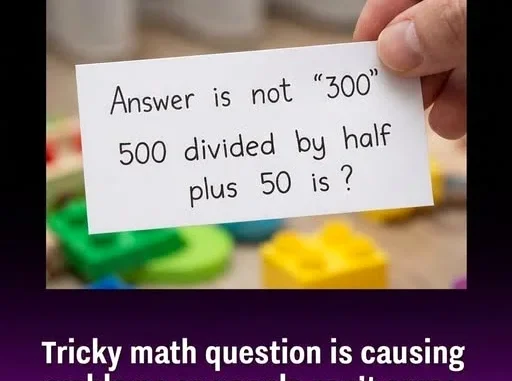
Math puzzles that seem simple at first glance often captivate large audiences online. These puzzles typically rely on subtle language nuances or common misunderstandings rather than complex calculations. One such puzzle that has sparked widespread discussion involves the expression: 500 ÷ half + 50 = ?
At face value, this appears to be straightforward arithmetic, but many people arrive at different answers depending on how they interpret the phrase "divide by half." Understanding why this occurs requires examining both the math and the cognitive processes involved.
How Division by Fractions Works
Division by a fraction is a concept that can be counterintuitive. When you divide a number by a fraction less than one, the result is larger than the original number. This is because division asks, "How many times does the divisor fit into the dividend?"
For example, dividing 10 by ½ asks: "How many one-half units are in 10?" Since each whole contains two halves, 10 wholes contain 20 halves. Thus, 10 ÷ ½ = 20.
Applying this principle to the puzzle, 500 ÷ ½ means "How many halves are in 500?" The answer is 1,000 since each whole contains two halves. After this step, adding 50 gives 1,050.
Common Misinterpretations
Many people mistakenly interpret "divide by half" as "divide by two." This confusion arises because the word "half" is often associated with the number two in everyday language. Consequently, they perform 500 ÷ 2 = 250, then add 50 to get 300.
This shortcut seems reasonable but overlooks the mathematical difference between dividing by a fraction and dividing by a whole number. Dividing by one-half effectively doubles the number, whereas dividing by two halves it.
The Role of Mental Shortcuts
Psychological research identifies heuristics as mental shortcuts the brain uses to simplify decision-making. While these shortcuts are efficient, they can lead to errors in situations requiring precise interpretation, such as math problems with ambiguous wording.
In this case, the brain’s tendency to associate "half" with "two" leads to a quick but incorrect solution. The puzzle exploits this heuristic, encouraging readers to rely on instinct rather than detailed analysis.
Importance of Careful Reading
This puzzle underscores the value of reading instructions carefully before attempting calculations. A single word or phrase can significantly alter the meaning of a problem. Taking time to interpret the wording accurately can prevent mistakes not only in math but in various real-life contexts like following instructions or contracts.
Educational Implications
Teachers often emphasize understanding the problem statement as a critical step in problem-solving. This example illustrates that the arithmetic itself may be simple, but the key challenge lies in correctly interpreting terms. Educators can use puzzles like this to help students develop attention to detail and critical thinking skills.
Why Such Puzzles Are Popular
Puzzles that combine simplicity with a twist are widely shared because they challenge assumptions and provoke discussion. They serve as a playful test of common knowledge and encourage sharing solutions and explanations.
These puzzles provide an "aha" moment when the correct answer is revealed, reinforcing learning through surprise and engagement.
General Strategies for Avoiding Similar Mistakes
To avoid errors in problems involving fractions or ambiguous language:
- Pause and carefully read the problem statement.
- Translate words into precise mathematical expressions.
- Recall that dividing by a fraction less than one increases the original number.
- Double-check calculations before finalizing answers.
Conclusion
The expression 500 ÷ half + 50 = ? is a valuable example of how language and math intersect in ways that can confuse even experienced problem solvers. Division by fractions differs fundamentally from division by whole numbers, and recognizing this difference is crucial.
Beyond math, this puzzle teaches the importance of careful reading and critical thinking. By slowing down and analyzing problems thoroughly, we can avoid common pitfalls and improve our problem-solving accuracy in diverse areas of life.
Step-by-Step Solution
- Interpret "half" as the fraction ½ (or 0.5).
- Calculate 500 ÷ ½, which equals 1000.
- Add 50 to the result: 1000 + 50 = 1050.
Therefore, the correct answer to the puzzle is 1050.
Understanding such puzzles helps sharpen both mathematical knowledge and cognitive skills, making them a useful tool for learners and enthusiasts alike.
The Historical Context of Division by Fractions
Understanding division by fractions has been a fundamental part of mathematics for centuries. Ancient mathematicians, including those from Egyptian and Babylonian civilizations, developed early methods to handle fractions and their operations. The concept of dividing by a fraction as multiplying by its reciprocal dates back to these early mathematical traditions. This historical perspective highlights that while the arithmetic might seem straightforward now, the underlying principles have been refined over millennia to aid in precise calculation and problem solving.
Applications of Division by Fractions in Everyday Life
Though puzzles like "500 ÷ half + 50" are often seen as academic exercises, the concept of dividing by fractions appears frequently in real-world situations. For example, in cooking, if a recipe calls for half a cup and you want to find out how many half-cups make up a certain quantity, you are effectively performing division by a fraction. Similarly, in construction or manufacturing, measurements are often divided by fractional units to determine quantities or costs. Recognizing how division by fractions works can thus have practical benefits beyond classroom settings.
Developing Mathematical Confidence Through Puzzles
Engaging with puzzles that challenge common assumptions can build confidence in mathematical reasoning. Encountering a problem that initially seems simple but requires careful interpretation encourages learners to question their instincts and verify their understanding. This process fosters a growth mindset, where mistakes are seen as opportunities to learn. Over time, this approach helps develop resilience and flexibility in problem-solving, which are valuable skills in both academic and professional contexts.
Bridging Math and Language Skills
This puzzle exemplifies the close relationship between language comprehension and mathematical accuracy. Words like "half" carry specific mathematical meanings but can also be interpreted colloquially in ways that lead to confusion. Improving one’s ability to translate between verbal instructions and mathematical expressions is an important literacy skill. Educators and learners alike benefit from recognizing that math is not only about numbers but also about understanding language precisely.
Media Literacy and Critical Thinking in the Digital Age
The rapid spread of puzzles like this one on social media platforms underscores the importance of media literacy and critical thinking. Users often encounter brief, attention-grabbing content that encourages quick responses. While this can be engaging, it also increases the risk of accepting initial impressions without deeper analysis. Developing habits such as pausing to reflect, verifying information, and considering alternative interpretations can enhance one’s ability to navigate digital content thoughtfully.
Using Puzzles as Tools for Collaborative Learning
Math puzzles serve as excellent tools for group learning environments. Discussing different approaches and interpretations in a collaborative setting allows participants to articulate their reasoning and learn from peers. This interaction can reveal common misconceptions and provide diverse perspectives, enriching the learning experience. Teachers and facilitators can leverage such puzzles to promote dialogue, active listening, and collective problem-solving skills.
Cognitive Science Insights on Heuristics and Biases
The mental shortcuts, or heuristics, that lead to errors in puzzles like this have been extensively studied in cognitive science. Researchers have identified various biases that affect judgment, including confirmation bias, where individuals favor information that aligns with their preconceptions. Understanding these cognitive tendencies can help individuals recognize when their intuition might be misleading and encourage more deliberate thinking strategies.
The Legacy of Simple Math Puzzles in Education
Simple math puzzles have long been a staple in educational settings due to their ability to engage students and illustrate key concepts. They often serve as gateways to more complex topics by building foundational skills in reasoning and attention to detail. Over time, such puzzles have contributed to pedagogical approaches that emphasize conceptual understanding over rote memorization.
Career Relevance of Mathematical Precision
In many professional fields, from engineering to finance, the ability to interpret data and instructions accurately is crucial. Misunderstandings similar to those in this puzzle can lead to significant errors with costly consequences. Developing precision in mathematical interpretation early on lays groundwork for effective decision-making and problem-solving in various careers.
Takeaways for Lifelong Learning
The lessons from this puzzle extend beyond mathematics. They remind us to approach problems—whether numerical, verbal, or situational—with curiosity and care. Being mindful of context, questioning assumptions, and embracing complexity are habits that support lifelong learning and adaptability. In a world that often values speed, this puzzle champions the virtues of patience and thoughtful analysis.
Summary
This additional exploration reinforces that the puzzle about dividing by half is more than a simple arithmetic challenge. It connects to historical mathematical development, everyday applications, cognitive processes, educational strategies, and broader life skills. By reflecting on these dimensions, readers can appreciate the richness behind seemingly simple problems and the importance of careful, critical thinking in all areas of life.
The Influence of Language Ambiguity on Mathematical Interpretation
Language ambiguity can significantly affect how mathematical problems are understood and solved. The phrase "divide by half" is a prime example, where the use of everyday language clashes with precise mathematical terminology. Such ambiguities highlight the importance of clear communication in educational materials, textbooks, and even informal puzzles. Educators and content creators must be aware that subtle differences in wording can lead to drastically different interpretations and outcomes.
In professional settings, ambiguous instructions can cause errors and inefficiencies. For instance, in technical manuals or financial documents, vague phrasing may lead to miscalculations or misinterpretations. This puzzle serves as a reminder that clarity in language is vital not only in mathematics but across various disciplines where precise instructions are essential.
The Role of Mathematical Notation in Reducing Confusion
Mathematical notation exists partly to eliminate ambiguity in communication. Unlike verbal expressions, symbols and equations provide a standardized way to convey operations and relationships. Writing the puzzle as "500 ÷ (1/2) + 50" explicitly shows the division by a fraction, reducing the chance of misinterpretation.
Encouraging learners to translate word problems into symbolic expressions can help clarify the intended operations. This practice strengthens their ability to navigate between language and mathematics, fostering deeper comprehension and accuracy.
The Educational Value of Mistake Analysis
Analyzing common mistakes, such as confusing division by half with division by two, offers valuable educational opportunities. When students understand why certain errors occur, they can develop strategies to avoid them in the future. Teachers can incorporate error analysis into lessons to promote metacognition — thinking about one’s own thinking — which is essential for mastering complex subjects.
Furthermore, discussing errors openly reduces stigma around making mistakes, framing them instead as natural and useful parts of the learning process. This approach cultivates a growth mindset, encouraging perseverance and resilience.
The Intersection of Numeracy and Critical Thinking Skills
Numeracy—the ability to understand and work with numbers—is a foundational skill in modern society. However, possessing numeracy alone is insufficient without critical thinking abilities. This puzzle exemplifies how combining numerical skills with careful reasoning leads to correct solutions.
Critical thinking involves questioning assumptions, analyzing information carefully, and considering alternative interpretations. Developing these skills equips individuals to solve problems effectively, evaluate information critically, and make informed decisions in diverse contexts.
The Impact of Digital Media on Puzzle Popularity and Learning
The rapid sharing of puzzles like this one on digital platforms has transformed how people engage with math challenges. Social media facilitates widespread dissemination, enabling users to encounter and discuss problems they might not see otherwise.
While this can enhance learning and curiosity, it also presents challenges. The brevity and speed of online interactions may encourage snap judgments rather than reflective thinking. Users may prioritize quick answers over understanding, potentially reinforcing misconceptions.
Educators and content creators can harness digital media’s reach by designing interactive and explanatory content that promotes deeper engagement. Encouraging users to explore reasoning behind answers rather than just the final result enriches the learning experience.
Cognitive Load and Problem-Solving
Cognitive load refers to the amount of mental effort used in working memory. Problems that seem simple but contain hidden complexities can increase cognitive load unexpectedly, leading to errors.
In the case of this puzzle, the initial interpretation feels straightforward, so the brain allocates minimal effort. However, the subtlety of dividing by a fraction increases cognitive demands when the correct method is considered.
Understanding cognitive load can help learners manage their approach to problems by recognizing when to slow down and allocate more attention. Teaching strategies such as breaking problems into smaller steps and verifying each part can alleviate cognitive overload.
Cultural Perspectives on Mathematical Language
Different languages and cultures may express mathematical concepts in varying ways, which can influence interpretation. The phrase "divide by half" might translate differently, affecting how learners approach similar problems internationally.
Recognizing these variations underscores the importance of context-sensitive teaching and the need for clear, universally understandable materials. It also highlights the role of language proficiency in mathematical performance and the benefit of integrating language support in math education.
The Puzzle’s Place in Mathematical Recreation
Mathematical recreation, which includes puzzles, games, and brainteasers, plays a significant role in popularizing mathematics. Such activities make math accessible and enjoyable, sparking interest beyond academic requirements.
This puzzle fits within that tradition by combining simple arithmetic with a twist that challenges assumptions. It encourages playful exploration and discussion, helping to demystify math and promote a positive attitude toward problem-solving.
Encouraging lifelong engagement with mathematics through recreational problems can contribute to numeracy skills and cognitive health across the lifespan.
Strategies for Effective Communication of Mathematical Concepts
To minimize misunderstandings like those in this puzzle, educators and communicators can adopt several strategies:
- Use precise language and clarify terms that may have multiple meanings.
- Include symbolic representations alongside verbal explanations.
- Provide examples illustrating common misconceptions.
- Encourage questions and discussions to surface and address ambiguities.
- Design assessments that test understanding of concepts, not just computational skills.
By implementing these approaches, the gap between language and mathematical understanding can be bridged more effectively.
Final Reflections on the Puzzle’s Broader Lessons
Beyond the specific calculation, this puzzle serves as a metaphor for challenges encountered in learning and decision-making. It reminds us that initial impressions are not always accurate and that taking the time to analyze information carefully can lead to better outcomes.
Whether in mathematics, communication, or everyday problem-solving, cultivating patience, attention to detail, and a willingness to question assumptions are invaluable skills. This simple math puzzle, therefore, offers insights far beyond numbers, touching on cognitive processes, educational practices, and effective communication.